


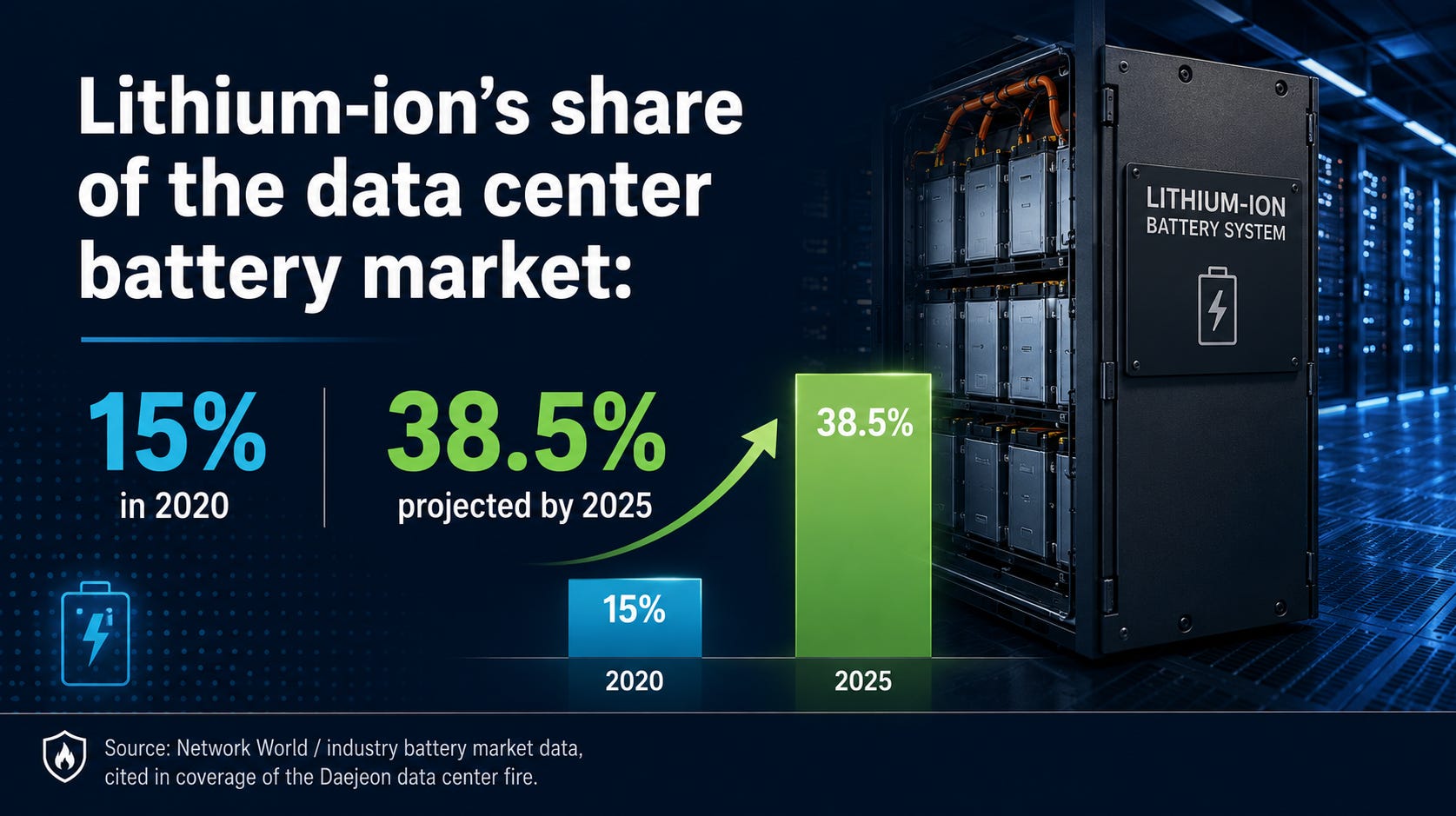
In a video update from Berkeley, Sherman lays out a claim he’s been building toward since he first raised it on For Humanity last fall: that virtually every data center running lithium-ion batteries is out of step with the safety framework built to govern how those batteries get stored, and that the gap is about to become impossible to ignore.1
What UL 9540 actually is
UL 9540 is Underwriters Laboratories’ safety standard for energy storage systems, covering “electrical, electrochemical, mechanical and other types of energy storage technologies for systems intended to supply electrical energy,” according to UL Solutions. It applies to commercial, industrial and utility-scale battery storage, and explicitly to uninterruptible power supply systems running lithium-ion batteries, the kind that sit in server racks and closets to keep a data center running through a grid outage.
There’s a carve-out worth knowing: per UL’s own language, “systems using lead acid...batteries...that only serve an uninterruptible power system (UPS) application are outside the scope of this standard,” per Mitsubishi Electric’s technical summary. Lead-acid UPS batteries have been standard in data centers for decades. The regulatory pressure John is describing applies specifically to the newer lithium-ion installations that are rapidly replacing them, which is exactly the buildout driving the current AI data center boom.
The physical separation Sherman describes, the “metal box that can keep the fire inside the metal box,” is closer to how NFPA 855 and UL 9540A’s fire propagation testing are applied in practice: dedicated rooms or enclosures, fire-rated separation, and spacing requirements once a battery installation crosses a certain size. Whether a given data center is in compliance depends on its jurisdiction, its battery chemistry, its installation size, and whether local fire officials have adopted and are enforcing the current code, since these are largely enforced at the state and municipal level rather than by a single federal mandate.
Sources: UL Solutions, UL 9540 overview | Mitsubishi Electric, understanding the UL 9540 listing | NFPA Journal, the lithium-ion battery risk inside AI data centers
The fire that made this real
This isn’t a hypothetical. In September 2025, a lithium-ion battery explosion at South Korea’s National Information Resources Service facility in Daejeon knocked 647 government systems offline for nearly a week, according to Network World’s reporting. Ninety-six systems were destroyed outright and 551 more were shut down as a precaution. The batteries involved, 384 of them, had been installed in 2012 and 2013 and had already outlived their rated lifespan, despite passing a safety inspection two months earlier.
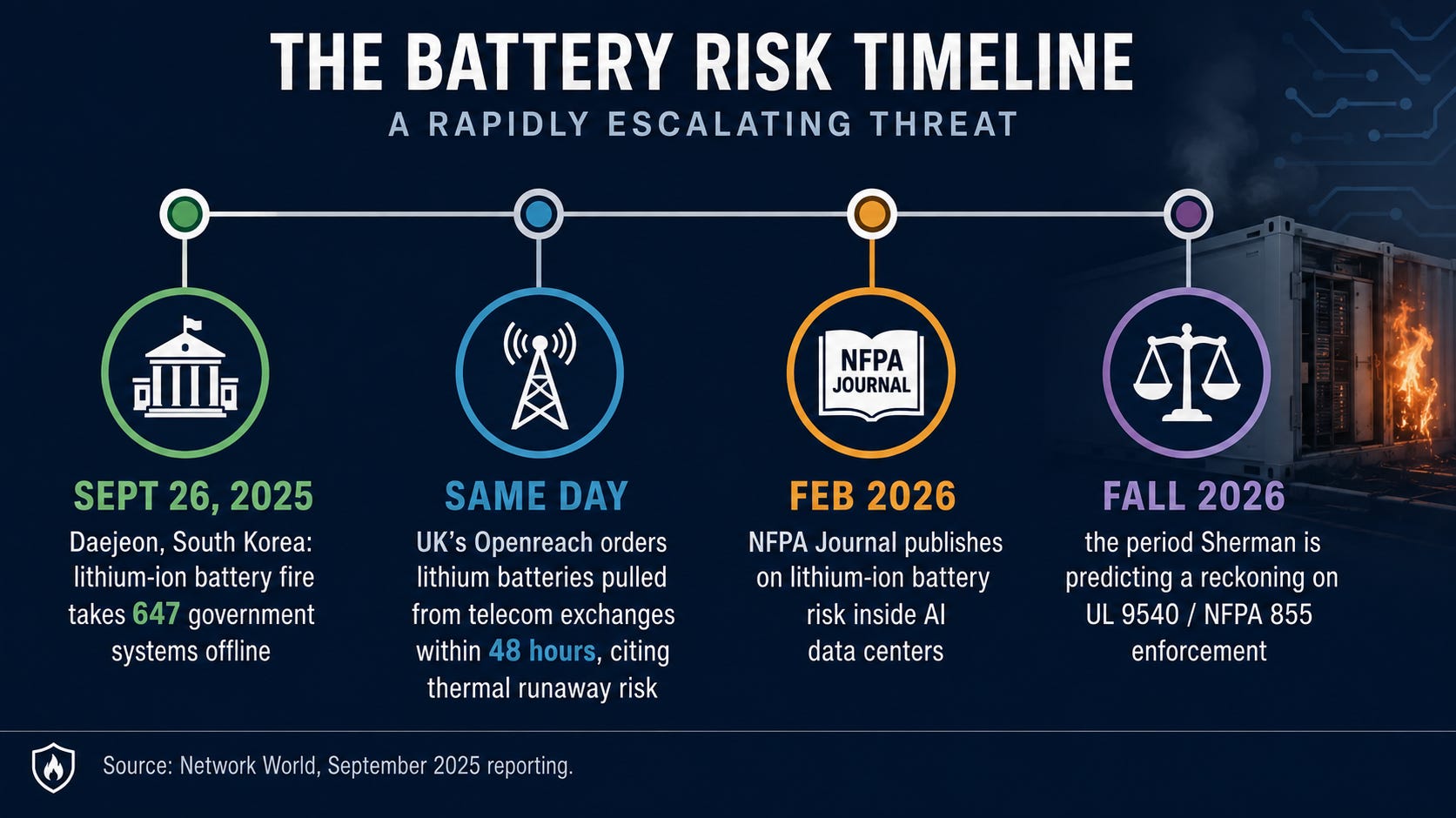
The same day as the Daejeon fire, UK telecom operator Openreach issued an emergency directive ordering lithium batteries removed from its exchanges within 48 hours, citing “the significant risks of thermal runaway, fire and explosion.” South Korea recorded 55 separate UPS-related fires between 2018 and October 2022. None of this proves Sherman’s “every single data center” line as a literal, audited fact. It does show that the underlying hazard he’s pointing at is not a fringe concern, and that at least one regulator has already moved fast and hard in response to it.
Sources: Network World, South Korea’s data center fire triggers global scrutiny
Why this doubles as an AI safety story
Sherman’s interest here isn’t fire code for its own sake. His argument is that a regulatory reckoning over battery storage safety would land directly on the AI buildout, because every hyperscale data center under construction right now is also a lithium-ion battery installation at a scale the fire code world hasn’t fully absorbed yet. If compliance costs rise, or if fire marshals start enforcing separation and testing requirements more aggressively on new builds, that’s friction on the same data centers supplying the compute behind frontier AI models. Slower, more expensive data center construction would mean less incoming compute for those models, which is the connection Sherman draws between a fire-safety standard and the broader AI risk fight.
That’s Sherman’s read on where this goes, not a settled outcome. Whether UL 9540 and NFPA 855 enforcement actually tightens this fall, and whether that translates into a meaningful slowdown in AI compute buildout, is exactly what he says to watch for.
The takeaway
The regulation is real, the underlying fire risk is documented and growing as lithium-ion batteries take over from lead-acid in data center UPS systems, and enforcement is currently uneven and locally decided. Whether that gap becomes “the biggest deal in tech” this fall, as Sherman is predicting, is a bet on how fast fire marshals, insurers and AHJs move on a standard that’s been on the books for years while the buildout raced ahead of it.
Take action on AI risk subscribing now!
RESOURCES FROM THIS VIDEO
Primary / standards documentation
UL Solutions: Energy Storage System Testing and Certification (UL 9540 overview)
UL Solutions: UL 9540A Test Method for Battery Energy Storage Systems
NFPA Journal: The Lithium-Ion Battery Risk Inside AI Data Centers (Feb 2026)
Reporting
If this was useful, restack it.
A note on the audio: Sherman refers throughout to “UL 9540” as the standard requiring physical separation of battery storage. UL 9540, the Standard for Energy Storage Systems and Equipment, is real and does cover lithium-ion UPS systems in data centers. But the specific containment requirement he describes - batteries kept in something like a separate fire-rated enclosure - is the piece most directly governed by NFPA 855, the fire code that sets separation distances and dedicated-room requirements for battery energy storage above certain thresholds, working alongside UL 9540A’s fire propagation testing. The two standards are closely linked and often discussed together in industry coverage. This post uses “UL 9540” where Sherman uses it and adds the NFPA 855 context where it clarifies which rule actually does what.


